fredag 27 april 2012

torsdag 26 april 2012
Gertrude Hermes
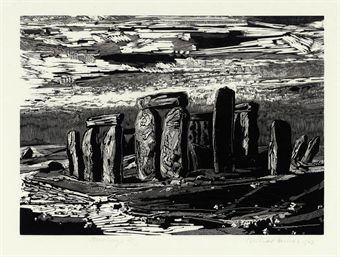
A blogger called “Bibble”
wrote on his blog (http://www.clivechristy.com/2010/04/gertrude-hermes-1901-1983.html) that “when other artists went on
to capture nature and the idyllic conceptions of rural life her poetic
imagination seems to have taken graphic form inevitably upon the wood itself as
the lights responded to the tool’s inspired incisions”.
References:
North House Gallery http://www.northhousegallery.co.uk/exhibitiondetail.asp?exID=40
Random website http://myweb.tiscali.co.uk/sevenpillarsofwisdom/hermes.html
A´lea iacta est
Before my
career in the deep world of arts I studied Natural Science and Mathematics. I
spent hours and hours in seminars I didn’t really want to pay attention to.
Mathematic formulas, chemistry and scientific theories were launching it selves
through my head. To relax my other senses and to be able to concentrate my mind
I started doodling during class. My doodles became more and more serious and
what was previous just a random hobby became more and more a solid interest. But of course it wasn’t just born out of nothing;
when I was young I started using computers at an early age and started copying
from Marvel Comics and old Japanese samurai drawings.
When I got
older street art became a greater influence than before and I started to find
my style of a mix of comics and street art. What really was a mile stone in my
life was starting UNI, to actually get projects with deadlines were I have to
always push myself into drawing new things I have never drawn before. The
skills everyone picked up during previous art studies is a constant reminder
and I envy them at the same time as it creates a hunger to beat them.
”a´lea iacta est” – ”
The die has been cast”
James Hensher
Quite out
of nowhere my girlfriend introduced me to an half English/Swedish artist who is
up and coming on the Swedish market. James Hensher was born in Stockholm 1979
and brought up in an artistic environment. Hensher, James (http://jameshensher.com/). He studied art at the Falmouth
College of Arts in England and at the Van Der Kelen’s Institut Superieur de
Peinture in Belgium and does mainly paint with acrylics on canvas. His work is highly
colorful and it is a lot of focus around faces and the naked female body.

The world
of acrylics is something that I do wish to immerse myself in to.

References:
Hensher, James online (http://jameshensher.com/)
images: Hensher, James online (http://jameshensher.com/)
ROA
 Roa, a Belgium
street artist from Ghent who paints unbelievable illustrations of animals,
dissected, whole, craniums and the body or just some organs hanging out on big
murals. We are back at semiotics again; it is so hard to get away from…
Roa, a Belgium
street artist from Ghent who paints unbelievable illustrations of animals,
dissected, whole, craniums and the body or just some organs hanging out on big
murals. We are back at semiotics again; it is so hard to get away from…
“FC: What's the idea
behind showing animals organs?
Organs are the vital substances of our body and they represent a lot of symbolism which i like! Painters like Rembrandt did it ages before me, slaughter paintings!”
Organs are the vital substances of our body and they represent a lot of symbolism which i like! Painters like Rembrandt did it ages before me, slaughter paintings!”
Quote from an interview with ROA on http://www.fatcap.com/article/roa.html
He is currently active with a solo exhibition and book launch at Stolen
Space gallery in Brick Lane called “Hypnagogia” “a 2 space exhibition features installation
work and originals on found objects” – Stolen Space.

 Later on that evening when me and my girlfriend went to his exhibition
at Stolen Space we ran into him again. This time I was being cleverer and
handed out one of me t-shirts, my contact details and 3 screen printed
postcards. He promised to wear my t-shirt while he was painting to make some PR
for me. You never know if it’s going to go anywhere but it’s worth a shot.
Later on that evening when me and my girlfriend went to his exhibition
at Stolen Space we ran into him again. This time I was being cleverer and
handed out one of me t-shirts, my contact details and 3 screen printed
postcards. He promised to wear my t-shirt while he was painting to make some PR
for me. You never know if it’s going to go anywhere but it’s worth a shot. References:
Stolen Space http://www.stolenspace.com/section.php?xSec=505
Street Art London http://streetartlondon.co.uk/artists/roa/
Fat Cap http://www.fatcap.com/article/roa.html
photos: Rios, Sandra (c) 2012
image: http://www.stolenspace.com/shopimages/products/normal/roa/roa_fs_2.jpg
BCN here I come?
The better
part of 2011 I spent in Barcelona, Spain. Times were worries and thoughts about
anything serious were blown by the wind in a city with approx. 5 mil people
(with all the urban areas counted) which halves of the 5 mil are people with
their hands (maybe even as far to the hips) covered in creativeness. I already had a big interest for art but when I
was surrounded by artist and non the least the street art that flourish all
over town you can’t help being inspired.
The main reason to why it’s so good is
blatantly because it’s just so much art all around you never mind laws about
where and how. Because there is so so
many different artists it is also a great variety of art which suits even the
most uninterested person.
It feels
like that everywhere that you go you are moving through the same exhibition of
many thousands of artists work in an urban jungle. Barcelona inspired me to
really kick it off with art which I deeply appreciate ‘cause this is what I want
to do.
Bajs-collective is born!
 I and two aspiring artists in year 1 illustration & printmaking are putting together
a brand/company/clothing line. We (at the moment of course) do not
know anything other than what our common (even though common sense isn’t that
common) sense tells us about creating a company. But while studying courses that
try to prepare you for the future “working life” what is not better than to
actually start working with what you do want do to?
I and two aspiring artists in year 1 illustration & printmaking are putting together
a brand/company/clothing line. We (at the moment of course) do not
know anything other than what our common (even though common sense isn’t that
common) sense tells us about creating a company. But while studying courses that
try to prepare you for the future “working life” what is not better than to
actually start working with what you do want do to?
In the beginning we
focus on t-shirts as step one to practices screen printing and all the
techniques to fully be able to conquer textile printing. Since 2 weeks back I've made 2 t-shirt
designs and printed one in a series of 4 and the other of 5. All of them except
2 t-shirts are sold and I already have another 10-15 booked by various friends
all over Europe.

 |
| Ibinson, Jason |
A new era is born!
Prints and t-shirts for sell.
References:
Elerud, Claes (2012) http://itsnotwhatitis.blogspot.co.uk/
Images and artwork (c) Claes Elerud
Last image artwork (c) Jason Ibinson
Images and artwork (c) Claes Elerud
Last image artwork (c) Jason Ibinson
onsdag 25 april 2012
Eric Gill
Eric Gill
said to be one of the greatest craftsmen of the twentieth century and his art
is well known all over the world. He wasn’t just any British sculptor, typeface designer, stonecutter and printmaker as my research gets deeper I am
starting to read more and more quite disturbing facts. His artwork is strongly
inspired by religious views but also highly erotic and some say pure blasphemy.
On the website http://www.traditioninaction.org/HotTopics/j005htGill_Distributism_Odou.htm Patrick Odou roast him quite
hard but also a lot of interesting facts (which doesn’t seem far off from what I
picked up in my research).

Patrick Odou writes on
his website that Fiona MacCarthy wrote “Eric Gill” a biography released
1990 in which she reports that his sexual obsessions included adultery, incest,
and pedophilia. He had sexual intercourse with two of his sisters and two of his
daughters.
Famous people always
seem to have the biggest luggage.
References:
Odou, Patrick online (http://www.traditioninaction.org/HotTopics/j005htGill_Distributism_Odou.htm)
Eric Gill website (http://www.ericgill.com/index.php)
The Eric Gill Society (http://www.ericgill.org.uk/)
Image: http://www.goldmarkart.com/images/art/23/23_1640_m.jpg
References:
Odou, Patrick online (http://www.traditioninaction.org/HotTopics/j005htGill_Distributism_Odou.htm)
Eric Gill website (http://www.ericgill.com/index.php)
The Eric Gill Society (http://www.ericgill.org.uk/)
Image: http://www.goldmarkart.com/images/art/23/23_1640_m.jpg
Wangechi Mutu

Wangechi
Mutu, born in 1972, Nairobi, Kenya and she lives and works in New york. She's been on the art scene since -97.
“Their evocation of the objectification of the wild and exotic other is
approaching the kinky seductiveness of the fashion spreads that are among the
things they seek to indict” Smith, Roberta (2006 June 9, The New York Times).


 It seems like
she creates new species based on horrors from African society, and uses small
means such as glitter to symbolize the illegal diamond trade that’s what’s semiotics
is all about right?
It seems like
she creates new species based on horrors from African society, and uses small
means such as glitter to symbolize the illegal diamond trade that’s what’s semiotics
is all about right?
References:
Saatchi
Gallery (http://www.saatchi-gallery.co.uk/artists/wangechi_mutu.htm).
images: http://www.saatchi-gallery.co.uk/imgs/artists/mutu_wangechi/20091124042523_wangechimutuprolapsusuterus.jpg
http://www.saatchi-gallery.co.uk/imgs/artists/mutu/wangechi_mutu_indurated.jpg
http://www.saatchi-gallery.co.uk/imgs/artists/mutu_wangechi/20091124042423_wangechimutucanceruterus.jpg
http://www.saatchi-gallery.co.uk/imgs/artists/mutu_wangechi/20091124042316_wangechimutufemalesexualorgans.jpg
Modernism
Revolution
and freedom of expressions are the words for modernism. As written on “Arts my passion” written by Nick, N (http://www.artsmypassion.com/articles.asp?ID=143 ) “Modernism rejected tradition and
was highly controversial at the time. It was revolution, as such, one that
paved the way for new ideas to take shape, which resulted in many new, and
exciting, Modern Art movements to evolve.”
According
to Britannica (http://www.britannica.com/EBchecked/topic/387266/Modernism) Modernism was created by the rapid
growth of cities, World War I and a radical break with the past in the arts. A
time of experimentation and search for new forms of expression that I believe
never will die.
Modernism
can be described as an experimentation of the human experience and the degree
of self-consciousness characterized by deviations from the norms of society.
In the book
“Introducing Modernism” Rodrigues, Chris (2001, pg4) state that all works that
can be accommodated under the umbrella of modernism share a relationship to the
modern world which is peculiarly new and exceptional to any other previous
cultural and historical condition.
He warn you about the dangers of confusing modernism with mainstream fashions,
modernism change the social dynamics and it is also essential to establish the
originality, who did what first, when and where. Rodrigues, Chris (2001, pg9)
Which in the
future I need to watch out for since I have never studied art or had that interest I have never really known what Modernism really is.
References:
Rodrigues, Chris (2002). Introducing
Modernism. London: Faber and Faber Ltd.
Nick, N
online (http://www.artsmypassion.com/articles.asp?ID=143)
Identity
 “As we use it now, an “identity"
refer to either (a) a social category, defined by membership rules and
(alleged) characteristic attributes or expected behaviors, or (b) socially
distinguishing features that a person takes a special pride in or views as
unchangeable but socially consequential (or (a) and (b) at once). In the latter
sense, “identity" is modern formulation of dignity, pride, or honor that
implicitly links these to social categories. “
“As we use it now, an “identity"
refer to either (a) a social category, defined by membership rules and
(alleged) characteristic attributes or expected behaviors, or (b) socially
distinguishing features that a person takes a special pride in or views as
unchangeable but socially consequential (or (a) and (b) at once). In the latter
sense, “identity" is modern formulation of dignity, pride, or honor that
implicitly links these to social categories. “
D.
Fearon, James (1999 http://www.stanford.edu/~jfearon/papers/iden1v2.pdf) "What is identity (as we now use the word)?"
I did quite a bit of research on the
net but I also started to read “Identity: a reader” du Gay, Paul, Evans,
Jessica and Redman, Peter (2000) London: Sage Publications . I read Phoebe
Rose’s blog (http://phoeberoses.wordpress.com/) where she writes about “Who am I”
and Alex Jordan’s blog (http://jordan1991alex.blogspot.co.uk/2012/04/identity-media.html) which is about identity and
the media. All of it is interesting and accurate and “Identity: a reader”
consists of facts and philosophical thoughts about identity to write 200 words
20 times.
I rather write about the
possibility to change your identity and I don’t mean to change your name, move
to a different country and start a new life. People are living their normal
lives with work from 9-5 and families and responsibilities, the identity
change may not even be known by people around you. Internet is a fascinating
world where the possibility to be anyone exists.
A perfect example of this is the
movie Catfish (http://www.youtube.com/watch?v=hh-qKqu3ZJ0). Universal Pictures wrote “A reality thriller that
is a shocking product of our times, Catfish is a riveting story of love,
deception and grace within a labyrinth of online intrigue.” which summarize
it without giving to much of the plot away. The story's about a married woman
who creates a network of people online with different personalities, voices and
completely different lives. This woman has a couple of cellphones and plays
with a single man’s emotional quest for love. It’s a capturing story which I believe
exists to a far greater extent than everyone believes.
References:
“Identity: a reader” du Gay, Paul, Evans,
Jessica and Redman, Peter (2000) London: Sage Publications
Image: http://online-identity-theft.net/online-identity-theft/11-7-million-persons-reported-identity-theft-victimization-in-2008
Semiotics
Semiotics affect us in everyday life even if you don’t
leave the house the amount of suggestions through images, ads, books, movies
and more are indescribable. But prior to semiotics it is necessary to
understand what a sign is. Some typical signs in everyday life are traffic signs,
toilet signs for male and female, no smoking signs pretty much everywhere and
much more. Others can be what a red heart or a couple of red roses signifies in
a post card to your loved one.
 |
| http://thehollywoodprojects.files.wordpress.com/2011/09/semiotics.jpg |
As said by Cobley,
Paul (2004, pg. 3) “The word ”semiotics”
comes from the greek root, seme, as in semeiotikos, an interpreter of signs. Semiotics
as a discipline is simply the analysis of signs or the study of the functioning
of sign systems. “
To break
down the symbolisms in an image/photography/ad/etc separate it into three
messages:
A “linguistic”
message - all the words in
the ad
A “coded
iconic” message - the connotations in
the photograph/image
A “non-coded
iconic” message -
The denotations in the photograph
From
Barthes’ 1964 essay, “The Rhetoric of the Image” and published in “Introducing
Semiotics” by Cobley, Paul (2004, pg. 47).
References:
Cobley, P (2004).
Introducing Semiotics. London: Faber and
Faber Ltd.
Image Emerson, Jim : http://thehollywoodprojects.files.wordpress.com/2011/09/semiotics.jpg
Image Emerson, Jim : http://thehollywoodprojects.files.wordpress.com/2011/09/semiotics.jpg
Prenumerera på:
Inlägg (Atom)